Baanj Dayang (Rakali) Wilam sculpture (2024)
- Artist name(s)Aunty Kim Wandin and Christine Joy
- Artwork typeSculpture
- Year installed2024
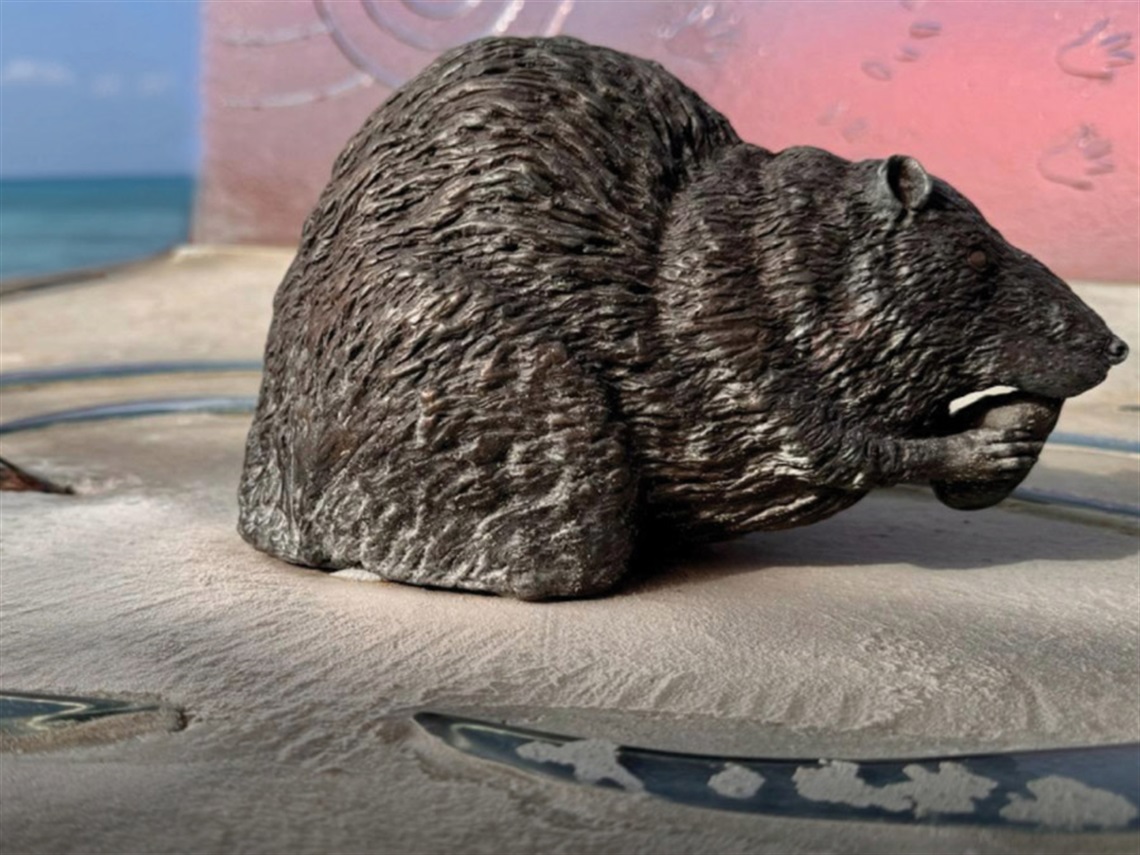
Baanj Dayang (Rakali) Wilam is a sculpture by Indigenous artist Aunty Kim Wandin and Christine Joy featuring a pair of local rakali (water rats), playfully emerging and returning to the water.
Ripples etched in concentric circles symbolise the rakali’s eternal connection to the place, as a significant entity in Aboriginal culture.
This public artwork celebrates 'Indigenous Cultural Heritage' together with 'local marine life and biodiversity of Port Phillip Bay' at the redeveloped Mentone Lifesaving Club.
The work features a combination of bronze, glass and concrete; the design team worked with Wathaurong Glass, an Aboriginal glass company to design the glass elements which feature Aboriginal iconography depicting rakali footprints and journey lines. The bronze rakali are life-like and life-size presenting the rakali’s interactions with their aquatic environment.
About the rakali
Baanj dayang is the Woi-wurrung name for aquatic animal, commonly known as the rakali (water rat). The rakali, Hydromys chrysogaster, means 'water mouse with golden belly'.
The word 'rakali' itself is from Ngarindjeri language which is the land around the Victorian/South Australia border, including the Coorong.
Rakali are one of Australia's largest rodents, characterised by webbed hind feet, white-tipped tail, long blunt nose, thick waterproof fur, and a tail that acts as a rudder when swimming.
They can be found residing in rock crevices in marine and freshwater habitats across Australia, avoiding the more arid environments. Until protective legislation was introduced, rakali were heavily hunted for their pelt.
As an apex predator, the rakali plays an important role in stabilising their local, natural ecological systems, signifying resilience and regeneration. They feed on crabs, shellfish, and other invertebrates, and play a vital role in controlling introduced pests like black rats and cane toads.
The main threats to the rakali now are habitat alteration, swamp drainage and predation by cats and foxes. Ongoing protection, enhancement and care for the surrounding coastal and marine areas helps to keep the rakali’s habitat thriving.
The rakali represents many concepts including playfulness and fun. This is depicted within Baanj Dayang (Rakali) Wilam as the rakalis emerge and return to the water to chase one another.
About the artists
Artists Aunty Kim Wandin and Christine Joy collaborated on this project with Public Art Specialist James Voller (Collide Public Art).
Aunty Kim Wandin is a Wurundjeri Woirurrung woman living in Healesville in the Yarra Valley. Her traditional name is Wandoon which means ‘spirits of the water’.
Aunty Kim is a basket and eel trap maker collecting reeds and other fibre plants on Country. The art of using reeds to make eel traps and baskets is a tradition handed down to her by her Nana Ollie, who was taught by Granny Jemima at Coranderrk.
Aunty Kim has worked as a Consultant and Cultural Educator, exhibited her work across arts organisations and her art has been acquired by private and state collections.
Christine Joy brings design, curation and community engagement expertise to the team. As a specialist in community programs and projects Christine’s prevailing passion is Aboriginal culture and its role in transforming social and environmental ecologies.
Collide is a public art initiative based in Melbourne. They aim to merge multiple fields and practices with sculpture as they seek to redefine how sculpture can be both socially and architecturally integrated. Collide works with a range of artists on both temporary and permanent public artworks, using the latest digital and architectural technologies.
During the concept development stage, the artists collaborated with Palawa artist Amanda Wright to incorporate sketches of the Rakali into the design of the sculpture.
Artist interview (Aunty Kim Wandin and Christine Joy)
What other public art projects have you worked on?
The design team have experience across a range of public art projects through their artistic partnership Murrup Biik.
- YERRIN BIIK DHUMBA, Yarra Ranges Regional Museum, Lilydale
- Djirra Binak at RBOUR-DEET, Poyner Reserve, Lilydale
- BAGURRK BIIK (Women Country), Yarra Ranges Civic Centre, Lilydale
- IUK (EEL) TRAP, Brungergalk, Watt's River Parkland, Healesville
- CARVED POLES, Bell Station, Preston
- YERRIN BIIK, Mooroolbark Library, Mooroolbark
- BIIK BIAL, Ascot Vale Primary School, Ascot Vale
- IUK (EEL) TRAP, Arthur Rylah Institute, Heidelberg
- BINAK BIIK, Telford All Abilities Sculpture Trail, Darley
- BILANG BIIK, South Yarra Siding Reserve, South Yarra
- NGARRERT, Hays Paddock Playground, Kew
- CARVED POLES, Wattle Park, Burwood
- IUK BAGURRK GUNGA, The National Gallery of Victoria (NGV), Naarm/Melbourne
Collide has worked with notable partners such as Mirvac, Billbergia, Citadines and City of Stonnington on public art pieces as well as major Rail Public artworks.
Can you please tell us a bit about the artwork and the story behind it?
The public artwork features a pair of playful rakali which are formed in bronze and will emerge and return to the water. Ripples etched in concentric circles symbolising their eternal connection to place, as a significant entity in Aboriginal culture.
Our design 'Rakali' captures the essence of this playful and intelligent animal that is resourceful and an excellent swimmer. To the design team, rakali symbolise playfulness and fun as it emerges from the water to chase its companion.
It also represents resilience in face of threat and danger, as well as adaptability as it navigates both fresh and saltwater habitats.
The rakali plays a vital role in the local environment as a peak predator stabilising the natural ecological systems.
What is the significance of the rakali?
The rakali Hydromys chrysogaster which means 'water mouse with golden belly', is a large semi-aquatic rodent living between freshwater and saltwater, linking the two aquatic environments, and symbolising their interconnectivity. The rakali features in the Wurundjeri creation story about how the platypus was created. In the story, the rakali and duck fell in love and eloped. Their children were born as dulai-wurrung (the platypus).
Over 50 Aboriginal words for the rakali remain. There would have once been many more. The fact the words remain indicates their importance in Aboriginal culture. This serves as a powerful symbol of Aboriginal resilience and renewal. The word 'rakali' itself is from Ngarindjeri language which is the land around the Victorian/South Australia border, including the Coorong. The presence of the words reflects the ubiquitous nature of the rakali, living in many habitats (marine and freshwater, across the continent, except for the most arid areas), but also their adaptability and resourcefulness.
Is the rakali native to Kingston?
Yes, the rakali is local to and protected in the area. Around this area they are marine animals feeding on molluscs and crustaceans. They use rock crevices as their homes.
About the project
There is ongoing support for the depiction of Indigenous cultural heritage along the Bay by the local Kingston community. During the feedback collected on the ‘Your Kingston Your Say’ platform in July and August of 2020 for artistic themes to be explored along the Bay Trail, ‘Indigenous Cultural Heritage’ featured amongst the most popular topic supported, along with the ‘The local marine life and biodiversity of Port Phillip Bay’.
Kingston Arts is excited to have partnered with Indigenous artist Aunty Kim Wandin and artist Christine Joy to deliver a public artwork that celebrates these themes at the redeveloped Mentone Lifesaving Club, 64 Bay Trail, Mentone 3194.
Artists Aunty Kim Wandin and Christine Joy collaborated on this project with Public Art Specialist James Voller (Collide Public Art).
During the concept development stage, the artists collaborated with Palawa artist Amanda Wright to incorporate sketches of the Rakali into the design of the sculpture.
Education resource
Download our Rakali education resource to learn more about the Rakali, and do some fun, creative activities.
Download(PDF, 2MB)
Access
A new ramp provides wheelchair access to the beach and this sculpture. Accessible toilets are available.
Acknowledgements
- Aunty Kim Wandin and Chrisine Joy: concept and design
- Collide Public Art: project management
- Natalie Ryan: plasticine modelling
- Fundere Foundry: bronze casting
- Eric Holmes (Skyview Industries): fabrication & installation
- Georg Ramm: rakali photography
- Amanda Wright: rakali sketches
- Landscaping: Jeavons.
Location
Mentone Lifesaving Club, Beach Road (opposite Kitchener Street), Mentone 3194 View Map
-37.989439,145.060074
Mentone Lifesaving Club, Beach Road (opposite Kitchener Street) ,
Mentone 3194
Mentone Lifesaving Club, Beach Road (opposite Kitchener Street) ,
Mentone 3194
Baanj Dayang (Rakali) Wilam sculpture